from the desk of Annette Walker

from the desk of Annette Walker

Tuesday, April 21, 2015


Dr. Howard Fuller:  Consummate Community Organizer, Pan-Africanist, and Education Reformer
               "Understanding the Relationship Between Struggle and Progress"
 A Presentation at Blair-Caldwell Library
       
by Annette Walker

     "No Struggle, No Progress", the title of Dr. Howard Fuller's new book, is a metaphor for his fifty years of organizing for social justice for the African-American community.
     He was inspired by the words of Frederick Douglass:  "Power concedes nothing without demand.  It never did, and it never will."
     "So struggle we must," Fuller said at a recent presentation held at the Blair-Caldwell African-American Research Library.
     "Understanding the relationship between struggle and progress is what propelled me down dark alleys and dirt roads in some of North Carolina's poorest communities in the 1960s, and pushed me into the bush, mountains, and war-torn villages of Africa nearly a decade later," he stated at the event sponsored by Democrats for education Reform.  "It is what pushes me still in the fight over one of the most contentious education issues of this era:  parental choice."
     Fuller also founded Malcolm X Liberation University in 1969 and was a Black Power advocate with an African name: Owusu Sadaukai.  "I got involved in the African Liberation Movement in the early 1970s and later even studied Marxism as a union organizer," he said. 
     A native of Shreveport, Louisiana who grew up in Milwaukee,  Fuller resolved to dedicate himself to the African-American struggle for social change as soon as he graduated from college in 1962.  The Civil Rights Movement was in full swing, but he had unconventional ideas about the path to social change.  These ideas have never allowed him to become merely a careerist.
     Although he decided to pursue social work, he was not interested in the traditional curriculum of case work and group therapy.  "I viewed those areas as helping people manage oppression, and I wanted no part of that," he writes.  "I wanted to help end oppression."
     He chose Western Reserve University (now Case Western Reserve) in Cleveland because it offered a new area of social work that correlated with his vision:  community organizing.  Throughout his life Fuller frequently has had to make decisions to change jobs and projects to be able to pursue his social justice vision.

     While in Cleveland he had two experiences that profoundly impacted his thinking and future work.  First, he participated in a peaceful demonstration and sit-in at the school administration building.  The police came and he, along with others, was beaten, taunted and charged with misdemeanors.  Secondly, a few weeks later he went to hear Malcolm X speak about the future of the civil rights struggle a talk became known as “The Ballot or the Bullet”.
     “And from the moment he opened his mouth, I was transfixed,” Fuller writes.  “The man was bold.  There was a raw honesty and bravery about Malcolm.  He not only made perfect sense to me, but he connected to something deep in my soul,” he continued.
     One month after Malcolm’s talk in Cleveland, Fuller finished his Master’s Degree.  His scholarship stipulated that he spend one year working for the Urban League, so he accepted a position as an employment relations specialist at its Chicago office.
     “I had much respect for the League and the role it played in the broader community, but it became clear to me that it would not provide the platform for me to do the kind of community organizing I yearned to do,” Fuller said.
     It was the mid-1960s and there was a vast expansion in the United States of programs and projects aimed at quelling the discontent in the African-American community.  Fuller accepted a job as coordinator of a North Carolina antipoverty program, Operation Breakthrough -- the first of many leadership positions he would hold throughout his life.
     Fuller was troubled by living conditions for African-Americans in Durham, North Carolina.  "Though I'd grown up in public housing and spent my earliest days in a poor southern community, I'd never seen poverty and neglect like this," he said.  "Dirt streets in the middle of town!  That was incomprehensible to me.  Shotgun shacks were everywhere, and some of them had no running water indoors.  My heart hurt when I saw how my people were living and how they had accommodated themselves to survive under conditions that no human being should have to endure.  Anger burned deep inside."
     Fuller's sentiments are not uncommon for African-Americans or for any humane person witnessing such a situation.  However, he did not despair.  "Far from feeling overwhelmed, it made me even more determined to figure out how to change the conditions." 
     A solution was right at hand.  "It would shape my whole approach to the work I wanted to do," he said.  It was a 'potent, but rarely-discussed line' in Section 202 of President Lyndon Baines Johnson's Economic Opportunity Act.  Fuller notes that ". . .it included a mandate that antipoverty programs receiving federal funds must be developed, conducted and administered with the 'maximum feasible participation' of residents of areas and members of the groups served."
     That constituted a 'eureka' moment for Fuller.  "The provision said to me that poor Black people, who had long been dictated to even by well-meaning whites, should play a major role in determining what they needed and how they should get it," he reasoned.
     Fuller had rejected the standard concept that the people social workers serve are 'clients'.  He also considered 'professional objectivity' and sitting in an office 'observing' anathema to what he really wanted to do.
     He and his team went to work.  His style of community organizing consisted of going to churches, barber shops, pool halls, restaurants, and residences.  "We got started simply by knocking on doors to get to know the people we were serving," he said.
     From that moment in 1965 until the present, Fuller has sought to involve the people who were being helped in determining their needs and strategies for solutions.
     Sometimes this method was criticized by the power structure, elected officials, donors, and the media.  For example, once a White North Carolina Republican Congressman attacked both Fuller and Operation Breakthrough at a press conference, calling for the program's suspension and Fuller's firing.
     Although this did not happen, the Congressman did succeed in banning direct participation in decision-making by the people served by the program.  Two years later Fuller decided to resign.  For the next several decades Fuller helped create many social and educational programs, always attempting to involve those being served.
     In the early 1970s he spent time in Africa, even going into "the bush" with freedom fighters of FRELIMO, the armed units in Mozambique seeking an end of Portuguese colonialism.
     When he returned to the United States, he made a decision to return to Milwaukee where he completed a Ph.D and began directing education programs.  In the early 1990s he was appointed as Milwaukee's Superintendent of Public Schools.  However, his ideas about education reform including vouchers clashed with some school board members and the teachers union. 
     "Just putting Black faces in high places will not change things because often institutional arrangements will not allow that," Fuller said.  He did not believe that what he wanted to do as Superintendent could happen with the established powers against him, so he resigned.
     However, as in the past, 'when one door closed, another door opened'.  In 2000 he became the first President of the Black Alliance for Educational Options (BAEO), the first Black-centered parental choice advocacy group.  It is also one of the few Black-led organizations participating in the broader education reform movement.
     As he looks back over the past 50 years, Fuller admits that there has been progress for some African-Americans, but he is concerned that some segments of the community seem to be trapped in poverty. "When I first landed in North Carolina fifty years ago, I truly believed I could help end poverty," Fuller concludes in his book. 
     "That youthful naivete vanished long ago," he continued.   "Education does not alter the fundamentals of the economic structure, but we hope that by educating kids, they will be in a position to have an impact on making structural changes in this country."
(This article appeared in the April 2015 edition of the Denver Urban Spectrum.)


Tuesday, July 15, 2014

Genocide and Slavery in the Sudan/South Sudan - 
Colorado Speaks Out
 by Annette Walker


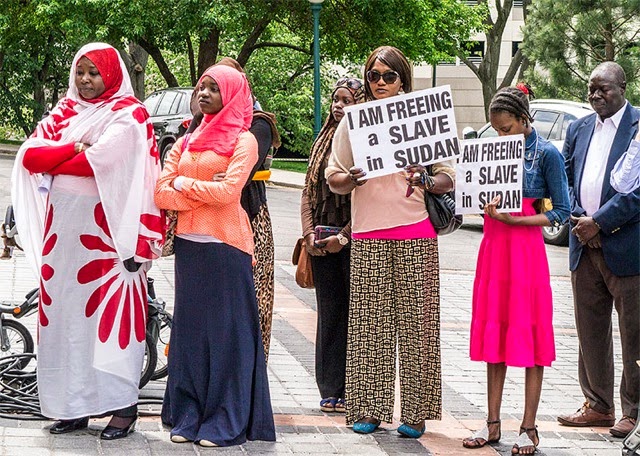
     "Our humanity is at stake unless we stand up and put an end to the deaths and incalculable suffering in the Sudan," said Rev. Heidi McGinness, Outreach Director for Christian Solidarity International-USA (CSI-USA).
     She spoke at a recent press conference and rally convened by CSI on the West Steps of the State Capitol.  The purpose was twofold.  First, she wanted to remind the public about the humanitarian crises -- specifically, genocide and slavery --  that for decades have devastated the Sudan.  The United Nations has declared that genocide and slavery anywhere are crimes against humanity.  She also wanted to launch a petition drive encouraging President Barack Obama to speak out about the atrocities in that African nation.
     Until 2011 the Sudan was Africa's largest nation in area.  The people were divided along ethnic and religious lines.  Many people who lived in the northern two-thirds of the country identified as Arab and Muslim.  The inhabitants of the southern region belonged to indigenous Black African ethnic groups, such as the Dinka and the Nuer.  Some practiced traditional African religions and others Christianity.  Although many languages are spoken throughout the nation, Arabic is the official language.
     Khartoum, the capital city, is located in the northern region which is the political, economic and military center.  There have been several attempts to govern it exclusively by Islamic law, and this is the goal of the current president, Omar Hassan al-Bashir, who assumed power by a military coup in 1989.
     "You can call it an apartheid system, between Arab and African Sudanese" said Rev. Oja Gafour, pastor of Denver's Sudanese Community Church.  "Even though the African Sudanese are the majority, we are treated as a minority and looked upon and treated as inferior.  Africans are being deprived of their land, resources, education and participation in political life," he continued.
     In the 1980s people in the southern region began organizing militarily in order to seek justice.  The Khartoum government struck back brutally, initiating a civil war.  The world has witnessed the horrifying results:  two million killed and four million forced to flee their homes.
     During this period slavery re-emerged.  Men, women and children are abducted and forced into slavery, and some end up in neighboring countries.  Estimates vary, but there are thousands enslaved.
     A separate conflict emerged in 2003 in the western region of Darfur.  Ironically, 90% of the people in Darfur are Muslims, but ethnically are Black African.  However, in the Arab vs. non-Arab system that exists, they are treated as outsiders.  When local rebel groups began to challenge the Khartoum government, the response was as brutal as in the southern region.  According the the United Human Rights Council, 400,000 have been killed and one million displaced.
                             
                                            International Response
     The genocide in the Sudan is not unique in global politics over the past 100 years.  The 20th century was the bloodiest in recorded history:  174 million people were killed in genocides and mass murders at the hands of dictators, warlords, and human rights violators.
     Throughout the 20th century there have been many international efforts to find a way to bring to justice the perpetrators, many of them high-level government officials and heads-of-state. 
     2002 marked a watershed moment when the International Criminal Court (ICC) was established in The Hague, Netherlands.  Its mission and mandate are noble: to hold accountable and bring to justice individuals responsible for war crimes and crimes against humanity.                   
     The mass murders in Darfur became one of the ICC's early cases.  In 2009 the ICC issued an arrest warrant for Sudan's president, Omar Hassan al-Bashir, on charges of masterminding genocide and other war crimes against the people in Darfur.  The Court always allows heads of government and other political officials to turn themselves in at The Hague.  Mr. Bashir has chosen not to do this.  However, last year he declined to attend the United Nations General Assembly in New York, an annual gathering of world leaders.
     In July 2011 a Peace Accord was signed and Africa's largest nation was divided into two countries: the Sudan and South Sudan.    Unfortunately, conflicts have continued and internal differences have destabilized the South Sudan.  Once again mass murders and population displacement haunt that new nation.  In May the UN Security Council issued a mandate to protect the one million civilians there, and 12,000 UN peacekeeping troops have been dispatched to the southern region.

                       Response from the United States including Colorado
      In 2004 the U.S. Congress voted unanimously to declare the situation in Darfur a genocide.  The Congressional Black Caucus called for divestment of the $91.2 billion U.S. dollars invested by federal and state pension funds in companies doing business in the Sudan.
     Thirty-five states including Colorado voted to divest their pension funds.  One of the co-sponsors of the Colorado legislation, which mandated a $42 million divestment, was former House Speaker Andrew Romanoff.  He was a featured speaker at the June Press Conference in Denver.
     Over the past decade there has been considerable human rights activity in Colorado regarding the situation in the Sudan and South Sudan.
     Christian Solidarity International's Outreach division is based in Denver.  CSI is the only human rights organization working to liberate enslaved persons in the Sudan and they have succeeded in obtaining freedom for thousands.
     The Colorado Coalition for Genocide Awareness and Action (CCGAA), is based in Denver.  Founder and Director Roz Duman spoke at the June press conference and rally.  "Never Again, we said after the Holocaust," she said.  "And Never Again, we said after Rwanda.  But here we are again in the 21st century and genocide continues to rear its ugly head.  We are our brothers' and sisters' keepers"
     For the past 4 years CCGAA has organized Youth Against Genocide Conferences.
     The Fourth Annual Sudan Freedom Walk took place the day following the June press conference.  It was held at Bear Creek Lake Park in Lakewood and was attended by over 100 people.  The Freedom Walk is a fundraiser and proceeds are used to pay to free slaves in the Sudan
     It was founded by Rebecca Bretz when she was a high school freshman.  She just graduated and will pursue Peace and Justice Studies in college..
     Denver's St. John's Episcopal Church is actively engaged with many partnership projects in South Sudan as well as the local Sudanese refugee community.  St. John's and the Diocese of Colorado are part of the Anglican Communion, the global network of Episcopal and Anglican church bodies.
     Denver currently is home to over 1,000 Sudanese refugees.  "None of us planned to leave the Sudan," said Rev. Gafour.  "We were forced out."  Another religious refugee in Denver is Bishop Andudu from the Nuba Mountain area.  Currently one of the youngest Anglican Bishops worldwide, he was forced to seek asylum when bombing began near his church.
     Project Education South Sudan (PESS).  In response to the high illiteracy rate, some of which resulted from the 20 year civil war, PESS's mission is to help fund and support the building of primary schools in rural South Sudan.  PESS also provides clean water wells, sewing machines and other kinds of equipment for rural living.  The organization serves 3000 children in 4 schools.
     Colorado Friends of the Lost Boys of Sudan.  CFLBS's goals are to assist in the general welfare, job training and other education of Sudanese refugees living in Colorado who are known as the Lost Boys and Girls of Sudan.  They have been orphaned by the prolonged civil wars.
Editor's Note:
Learn more about the letter to President Barack Obama at www.revheidimcginness.org.  Videos of the Sudan and South Sudan produced by journalist Tamara Banks can be accessed at www.youtube.com
     (This article appeared in the July 2014 issue of the Denver Urban Spectrum)


Tuesday, January 7, 2014

LOSING GROUND REPORT
     Colorado Blacks and Latinos Falling Behind Whites
                   Fair Share Jobs Takes Action
                          
                                                         by Annette Walker
                                                         
     For Colorado's African-American community 2013 has been at once cause for celebration as well as for dismay.  In January Barack Obama, this nation's first African-American president, was inaugurated for a second term.
     However, on Inauguration Day in Colorado a report was released which has cast a shadow over the euphoria generated by Obama's second victory.  Entitled 'Losing Ground', the report was prepared by the I-News Network, the investigative news affiliate of Rocky Mountain PBS.  Losing Ground documents that the African-American and Latino communities are losing many social and economic gains that resulted from the Civil Rights Movement.

     The report focuses upon family income, family structure, poverty rates, infant mortality, life expectancy, health, education, home ownership, and judicial issues.  The I-News team analyzed demographic data from six decades (1960-2010) of the U.S. Census Bureau.
     Colorado, however, is not isolated from the national social and economic situation.  Since 2008 media investigations, books, and analyses abound regarding the impact of the national economic crisis on the general population including racial minorities.  There is even a recently released film, "Inequality For All", (based on the writings of Robert Reich, former Secretary of Labor in the Clinton administration).  The film is an expose on the widening economic gaps and the diminishing middle class in the United States.
     The Losing Ground analysis, however, has startled many people because of the positive image of African-American achievement in Colorado and Denver in particular.
     "Denver has been seen for decades as a liberal bastion in terms of race relations," said Larry Borom, former president of the Denver Urban League and an adjunct lecturer at Metropolitan State University of Denver.
     "In the 1970s Ebony magazine placed Denver on a list of Best Cities for African-Americans," he continued.
     Although they constitute only 10% of Denver's population, African-Americans have often kept pace with cities with much larger populations.
     In the early 1950s George Brown became one of five African-American staff reporters on the 2,000 metropolitan daily newspapers throughout the United States.  In 1955 he became one of the few Blacks elected to a state legislature and in 197_ became this nation's first Black elected lieutenant governor.
     Another example is that by the late 1960s Denver had as many Black public school principals as New York City, in each case just a few.
     The Losing Ground report does indicate a positive trend for secondary education.
     High School Graduation.  The 2010 Census indicates an 86% graduation rate for African-Americans, up from 31 percent in 1960.  The rate for Latinos has improved, although the 65 percent significantly lags behind the 95 percent for whites.
     Unfortunately, other social and economic statistics indicate negative trends.
     Family Income.  In 1970 Black families earned 73 percent of white family incomes and Latino families earned 72 percent.  By 2010 Black families had dropped to 60 percent and Latinos 50 percent.
     Between 1970 and 2010 federal jobs fell from 6 percent of all jobs in the state to 3 percent.  In 1970 15 percent of all jobs held by African-Americans was in the federal sector.  By 2010 that figure had dropped to 6 percent.
     Furthermore, many thousands of Colorado's well-paying, blue-collar manufacturing jobs have disappeared.  In 1982 Pueblo's CF&I Steel employed 13,000 people.  By the 1990s there were only 1300 employees.
     In the 1950s and 1960s Denver's Gates Rubber company employed 5500 people.  It closed in 1991.  Samsonite Luggage company in previous decades had employed 5500 people.  When it closed in 2001 there were only 340 remaining.
     In 2010 Denver's general unemployment rate was 7.2 percent, but for African-Americans it was 14.4 percent.
     Family structure.  The percentage of single-parent families and the number of births to single mothers has soared among Black households,  50 percent of Black families in Colorado were headed by a single parent in 2010 compared to 25 percent of white families. 
     Infant Mortality.  Whites experience an infant mortality rate of 5 deaths per 1,000 live births.  This is lower than the national average.  Blacks in Colorado experience 15 deaths per 1,000 live births, and for Latinos the rate is 8 deaths per 1,000 live births.
     Life Expectancy.  In 2011 for Caucasians 80 years, compared to 79 for Latinos and 77 for African-Americans.
     Health.  Whites experience a diabetes death rate of 14 per 100,000 residents, while it was 36 for both Latinos and Blacks.  Blacks are more likely to suffer from asthma, diabetes, high blood pressure, prostate cancer and obesity than whites.
     Home Ownership.  In 1970 60 percent of Latino households were owner-occupied; now it's a little beneath 50 percent, compared to 70 percent for whites.  Ownership among Blacks has remained at about 40 percent.
     College Education.  The percent of whites with college degrees is 3 times higher than Latinos and double the Black rate.
     Incarceration Rates.  In 2010 about one in every 20 Black men was incarcerated in Colorado state prisons compared to one out of every 50 Latino males and one of every 150 white males.
                                             Community Dialogue

    
The I-News Team has a nontraditional relationship with the public.  News personnel rarely engage in face-to-face dialogue about issues with the public.  However, beginning in late January the I-News team initiated presentations on many campuses around the state as well as the Blair-Caldwell African-American Research Library.
     Subsequently, the Colorado Black Roundtable not only invited I-News to more than one monthly meeting, but spearheaded a Community Summit held in September at Manual High School.  Attended by a few hundred people, the Summit featured speakers representing a cross-section of the African-American community.
     Mayor Michael Hancock was the first speaker and gave an overview of his administration's achievements.  "Good things are happening in this city," he said.  Among these are 1,000 new businesses, thousands of jobs, youth summer employment programs, and free access for youth to municipal recreation centers and swimming pools.
     Hancock also emphasized the importance of strengthening families.  "Families that pray together, stay together," he continued.
     City Councilman Albus Brooks's district includes the downtown area and Northeast Denver.  Among his administration's achievements are a job training program for 30 youth in his district.  He also led a youth group to Kenya last year. 
     Brooks proposed a public meeting with officials overseeing major projects, such as the light rail expansion, to see how African-Americans can be included.
     State legislator Rhonda Fields will submit 2 legislative proposals.  a) Child care to enable low-income parents to participate in Workforce training programs; b) Funding for GED, trade and technical skills programs for adults.
     Representative Angela Williams who represents sections of Northeast Denver, Montbello and Green Valley Ranch, is considering the legislation for an increase in the minimum wage and for an analysis of Colorado's procurement contracts.
     Some speakers contended that government --- city, state and federal-- must assume major responsibility for turning around the 'losing ground' situation.
     "If these issues are not addressed, the entire state will pay a high price," said Laura Franks, Executive Director of the I-News Network.
     Larry Borom believes that there must be open dialogue between elected officials and the African-American community.  "Mayor Hancock may need to appoint a 'Czar' to deal with the issues shown in the Losing Ground report," he said.
     Other speakers emphasized community efforts.  "We can't wait on government," said Dr. Anthony Young, President of the Rocky Mountain Association of Black Psychologists.  "We have to work closely with the two institutions that we control--the Black church and the Black family," he said.
     Young suggested the creation of after-school programs.
                                          Fair Share Jobs
     Last year a group of African-Americans established a nonprofit organization, Fair Share Jobs, to broker employment opportunities for African-Americans.
     Fair Share Jobs currently has two projects:  a)  Seeking recruits for  Denver's Manager of Safety Cadet program.  Established 28 years ago, the program allows participants to train for the police, fire and sheriff departments, but is not restricted to those careers.  It includes free tuition at the Auraria campus plus a paid, part-time job in one of the safety departments.  Upon completion of college, some program participants have chosen to go to law school or enter other professions.
     Very few African-Americans take advantage of the program according to Barbara Jones, a staff person at the Manager of Safety's office.  "We encourage them to consider entering the program," she said.
     b)  Broker for inclusion of African-Americans for Aurora's Gaylord Hotel project and other development sites in metropolitan Denver.  The 1500-room Gaylord hotel to be constructed near Denver International Airport will require about 10,000 construction jobs and 2500 permanent positions.  Fair Share Jobs' goal is to guarantee 2500 jobs, both construction and permanent, for African-Americans.
          Fair Share Jobs is especially interested in getting positions for young, chronically unemployed individuals.  "Many Black youth are talented, although dispirited," said Billy Scott, a board member and also a speaker at the Summit.  "However, they are at the bottom of the political totem pole and no one pays attention to them," he continued.
          Scott said that there will be training and counseling for all selected for the positions.  Fair Share jobs has had meetings with Aurora Mayor Steve Hogan and Aurora City Council members.  "Hogan and some of the council members are responsive to the idea of inclusiveness," Scott said.
     The Colorado Black Roundtable may publish recommendations made by speakers and audience members at the Summit.

(This article appeared in the November 2013 edition of the Denver Urban Spectrum)