from the desk of Annette Walker

from the desk of Annette Walker

Tuesday, June 16, 2015

Rev. Patrick Demmer, Activist for economic Justice


                                  Rev. Patrick Demmer
                                  Activist for Economic Justice
                                  Frequent Speaker and Two Arrests

                                                  by Annette Walker

     Rev. Patrick Demmer's staunch advocacy for minimum wage increases and general economic justice is rooted in his life experiences.  His first job was at McDonald's.  That was the summer of 1967, he was 14 years old and his salary $2.50 an hour.
     "I am outraged that 50 years later the salary for that same job for full-time employees is $7.50 ," he said.  "That's a $5.00 increase or 3 percent over 50 years," he continued.
     "What's worse is that in 1965 my parents purchased a modest home in Park Hill for about $15,000.  Today that house is valued at $275,000, a 21 percent increase.  "McDonald's workers cannot purchase a home in Park Hill," said Demmer, Senior Pastor at Graham Memorial Church of God in Christ.
     "McDonald's is a billion dollar and international enterprise.  When my wife and I arrived in Athens, Greece, the first thing we saw near the airport was a McDonald's," he continued.

     Based on recent reports in the Denver Post, the cost of homes in many areas of metropolitan Denver are soaring and rent for a one-bedroom apartment is about $1200, an out-of-range amount for fast-food, retail and service industry workers.
     "When I worked at McDonald's, most employees were teenagers and young adults and we lived with our families," he said.  "That has changed."
     A recent study by the Berkeley Center for Labor Research and Education at the University of California reveals that most fast-food employees are heads-of-households and often have children.  Furthermore, since they cannot meet their basic needs with their low wages, they are forced to rely on various forms of public assistance, such as food stamps, Medicaid and child care subsidies.
     These costs are borne by taxpayers and are often referred to as “the hidden costs of low wages”.  The Berkeley study shows that nationally 52% of fast-food workers, 48% or home healthcare workers and 46% of childcare workers received public assistance.  Surprisingly, the study found that 25% of part-time (adjunct) college teachers, some with Ph.d degrees, receive some form of public assistance.
     The Economic Policy Institute (EPI) reports that Colorado ranks number 11 regarding economic inequality.  This is in contrast to recent media headlines that the state’s overall income grew more than 6 percent between 2008 and 2012.  However,   the EPI report shows that most of that increase went to the wealthiest 1 percent as opposed to the bottom 99 percent.
     Demmer is hardly alone with his concern about stagnant wages and the skyrocketing cost of living.  There is a “buzz” in the United States about the excesses of income inequality and it has blossomed into a minimum wage movement.  Some economists like Robert Reich, Treasury Secretary during the Clinton administration, have pointed out that low wages are a barrier to growth of the national economy.  The daily national newspaper USA Today has called this movement, 'the issue that just won't go away'.
     The fast-food workers campaign began in New York City in November 2012 with 200 workers walking off their jobs demanding a $15 hourly wage and the right to form a union without retaliation.  In May 2014 there were job actions in 150 cities, in December 2014, 190 cities and on April 15 of this year 200 cities.
     Actions have taken place in Denver in 2014 and in April.  During the September 2014 action, Rev. Demmer and two others sat down in the middle of East Colfax and Pennsylvania to draw attention to the workers' economic plight and subsequently were arrested.
     It wasn't his first arrest.  A few years ago Demmer participated in a Columbus Day protest, was arrested and shared a jail cell with Native American professor and activist Ward Churchill.

     MSNBC's Chris Hayes contends that the minimum wage campaign has 'entirely changed the politics of the country".        In June 2014 Seattle made history by transitioning the demands from the streets to official policy.  The City Council unanimously approved implementation of a $15 an hour minimum wage for public workers over the next few years.
     Since then Oakland. San Francisco, Los Angeles, Chicago, Washington, D.C. and the states of Alaska, Arkansas, and New York have announced plans for a minimum wage increase.  President Obama has endorsed raising the federal minimum wage, and the Democratic Party is holding discussions on the issue.
     Retail giants such as Walmart and Target have announced wage increases.  So has McDonalds, but there is "a devil in the details".  Only 10% of McDonalds workers are directly employed by the giant conglomerate.  The other 90% are employed by franchises which have the authority to set their own policies.
     The Service Employees Union International (SEIU) has been working for the fast-food workers' right to organize and will work on the McDonald's franchise issue.     

     "The struggle continues," said Rev. Demmer.  "The root of many social problems in our society has to do with the economy.  Since it it is incumbent upon the church to lead the fight and be a voice for the voiceless, I will continue in my role as advocate," he continued.

(This article originally appeared in the June 2015 edition of the Denver Urban Spectrum)

Tuesday, April 21, 2015


Dr. Howard Fuller:  Consummate Community Organizer, Pan-Africanist, and Education Reformer
               "Understanding the Relationship Between Struggle and Progress"
 A Presentation at Blair-Caldwell Library
       
by Annette Walker

     "No Struggle, No Progress", the title of Dr. Howard Fuller's new book, is a metaphor for his fifty years of organizing for social justice for the African-American community.
     He was inspired by the words of Frederick Douglass:  "Power concedes nothing without demand.  It never did, and it never will."
     "So struggle we must," Fuller said at a recent presentation held at the Blair-Caldwell African-American Research Library.
     "Understanding the relationship between struggle and progress is what propelled me down dark alleys and dirt roads in some of North Carolina's poorest communities in the 1960s, and pushed me into the bush, mountains, and war-torn villages of Africa nearly a decade later," he stated at the event sponsored by Democrats for education Reform.  "It is what pushes me still in the fight over one of the most contentious education issues of this era:  parental choice."
     Fuller also founded Malcolm X Liberation University in 1969 and was a Black Power advocate with an African name: Owusu Sadaukai.  "I got involved in the African Liberation Movement in the early 1970s and later even studied Marxism as a union organizer," he said. 
     A native of Shreveport, Louisiana who grew up in Milwaukee,  Fuller resolved to dedicate himself to the African-American struggle for social change as soon as he graduated from college in 1962.  The Civil Rights Movement was in full swing, but he had unconventional ideas about the path to social change.  These ideas have never allowed him to become merely a careerist.
     Although he decided to pursue social work, he was not interested in the traditional curriculum of case work and group therapy.  "I viewed those areas as helping people manage oppression, and I wanted no part of that," he writes.  "I wanted to help end oppression."
     He chose Western Reserve University (now Case Western Reserve) in Cleveland because it offered a new area of social work that correlated with his vision:  community organizing.  Throughout his life Fuller frequently has had to make decisions to change jobs and projects to be able to pursue his social justice vision.

     While in Cleveland he had two experiences that profoundly impacted his thinking and future work.  First, he participated in a peaceful demonstration and sit-in at the school administration building.  The police came and he, along with others, was beaten, taunted and charged with misdemeanors.  Secondly, a few weeks later he went to hear Malcolm X speak about the future of the civil rights struggle a talk became known as “The Ballot or the Bullet”.
     “And from the moment he opened his mouth, I was transfixed,” Fuller writes.  “The man was bold.  There was a raw honesty and bravery about Malcolm.  He not only made perfect sense to me, but he connected to something deep in my soul,” he continued.
     One month after Malcolm’s talk in Cleveland, Fuller finished his Master’s Degree.  His scholarship stipulated that he spend one year working for the Urban League, so he accepted a position as an employment relations specialist at its Chicago office.
     “I had much respect for the League and the role it played in the broader community, but it became clear to me that it would not provide the platform for me to do the kind of community organizing I yearned to do,” Fuller said.
     It was the mid-1960s and there was a vast expansion in the United States of programs and projects aimed at quelling the discontent in the African-American community.  Fuller accepted a job as coordinator of a North Carolina antipoverty program, Operation Breakthrough -- the first of many leadership positions he would hold throughout his life.
     Fuller was troubled by living conditions for African-Americans in Durham, North Carolina.  "Though I'd grown up in public housing and spent my earliest days in a poor southern community, I'd never seen poverty and neglect like this," he said.  "Dirt streets in the middle of town!  That was incomprehensible to me.  Shotgun shacks were everywhere, and some of them had no running water indoors.  My heart hurt when I saw how my people were living and how they had accommodated themselves to survive under conditions that no human being should have to endure.  Anger burned deep inside."
     Fuller's sentiments are not uncommon for African-Americans or for any humane person witnessing such a situation.  However, he did not despair.  "Far from feeling overwhelmed, it made me even more determined to figure out how to change the conditions." 
     A solution was right at hand.  "It would shape my whole approach to the work I wanted to do," he said.  It was a 'potent, but rarely-discussed line' in Section 202 of President Lyndon Baines Johnson's Economic Opportunity Act.  Fuller notes that ". . .it included a mandate that antipoverty programs receiving federal funds must be developed, conducted and administered with the 'maximum feasible participation' of residents of areas and members of the groups served."
     That constituted a 'eureka' moment for Fuller.  "The provision said to me that poor Black people, who had long been dictated to even by well-meaning whites, should play a major role in determining what they needed and how they should get it," he reasoned.
     Fuller had rejected the standard concept that the people social workers serve are 'clients'.  He also considered 'professional objectivity' and sitting in an office 'observing' anathema to what he really wanted to do.
     He and his team went to work.  His style of community organizing consisted of going to churches, barber shops, pool halls, restaurants, and residences.  "We got started simply by knocking on doors to get to know the people we were serving," he said.
     From that moment in 1965 until the present, Fuller has sought to involve the people who were being helped in determining their needs and strategies for solutions.
     Sometimes this method was criticized by the power structure, elected officials, donors, and the media.  For example, once a White North Carolina Republican Congressman attacked both Fuller and Operation Breakthrough at a press conference, calling for the program's suspension and Fuller's firing.
     Although this did not happen, the Congressman did succeed in banning direct participation in decision-making by the people served by the program.  Two years later Fuller decided to resign.  For the next several decades Fuller helped create many social and educational programs, always attempting to involve those being served.
     In the early 1970s he spent time in Africa, even going into "the bush" with freedom fighters of FRELIMO, the armed units in Mozambique seeking an end of Portuguese colonialism.
     When he returned to the United States, he made a decision to return to Milwaukee where he completed a Ph.D and began directing education programs.  In the early 1990s he was appointed as Milwaukee's Superintendent of Public Schools.  However, his ideas about education reform including vouchers clashed with some school board members and the teachers union. 
     "Just putting Black faces in high places will not change things because often institutional arrangements will not allow that," Fuller said.  He did not believe that what he wanted to do as Superintendent could happen with the established powers against him, so he resigned.
     However, as in the past, 'when one door closed, another door opened'.  In 2000 he became the first President of the Black Alliance for Educational Options (BAEO), the first Black-centered parental choice advocacy group.  It is also one of the few Black-led organizations participating in the broader education reform movement.
     As he looks back over the past 50 years, Fuller admits that there has been progress for some African-Americans, but he is concerned that some segments of the community seem to be trapped in poverty. "When I first landed in North Carolina fifty years ago, I truly believed I could help end poverty," Fuller concludes in his book. 
     "That youthful naivete vanished long ago," he continued.   "Education does not alter the fundamentals of the economic structure, but we hope that by educating kids, they will be in a position to have an impact on making structural changes in this country."
(This article appeared in the April 2015 edition of the Denver Urban Spectrum.)


Tuesday, July 15, 2014

Genocide and Slavery in the Sudan/South Sudan - 
Colorado Speaks Out
 by Annette Walker


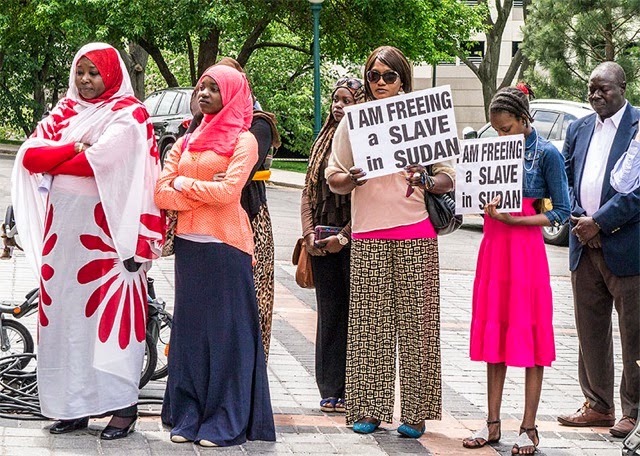
     "Our humanity is at stake unless we stand up and put an end to the deaths and incalculable suffering in the Sudan," said Rev. Heidi McGinness, Outreach Director for Christian Solidarity International-USA (CSI-USA).
     She spoke at a recent press conference and rally convened by CSI on the West Steps of the State Capitol.  The purpose was twofold.  First, she wanted to remind the public about the humanitarian crises -- specifically, genocide and slavery --  that for decades have devastated the Sudan.  The United Nations has declared that genocide and slavery anywhere are crimes against humanity.  She also wanted to launch a petition drive encouraging President Barack Obama to speak out about the atrocities in that African nation.
     Until 2011 the Sudan was Africa's largest nation in area.  The people were divided along ethnic and religious lines.  Many people who lived in the northern two-thirds of the country identified as Arab and Muslim.  The inhabitants of the southern region belonged to indigenous Black African ethnic groups, such as the Dinka and the Nuer.  Some practiced traditional African religions and others Christianity.  Although many languages are spoken throughout the nation, Arabic is the official language.
     Khartoum, the capital city, is located in the northern region which is the political, economic and military center.  There have been several attempts to govern it exclusively by Islamic law, and this is the goal of the current president, Omar Hassan al-Bashir, who assumed power by a military coup in 1989.
     "You can call it an apartheid system, between Arab and African Sudanese" said Rev. Oja Gafour, pastor of Denver's Sudanese Community Church.  "Even though the African Sudanese are the majority, we are treated as a minority and looked upon and treated as inferior.  Africans are being deprived of their land, resources, education and participation in political life," he continued.
     In the 1980s people in the southern region began organizing militarily in order to seek justice.  The Khartoum government struck back brutally, initiating a civil war.  The world has witnessed the horrifying results:  two million killed and four million forced to flee their homes.
     During this period slavery re-emerged.  Men, women and children are abducted and forced into slavery, and some end up in neighboring countries.  Estimates vary, but there are thousands enslaved.
     A separate conflict emerged in 2003 in the western region of Darfur.  Ironically, 90% of the people in Darfur are Muslims, but ethnically are Black African.  However, in the Arab vs. non-Arab system that exists, they are treated as outsiders.  When local rebel groups began to challenge the Khartoum government, the response was as brutal as in the southern region.  According the the United Human Rights Council, 400,000 have been killed and one million displaced.
                             
                                            International Response
     The genocide in the Sudan is not unique in global politics over the past 100 years.  The 20th century was the bloodiest in recorded history:  174 million people were killed in genocides and mass murders at the hands of dictators, warlords, and human rights violators.
     Throughout the 20th century there have been many international efforts to find a way to bring to justice the perpetrators, many of them high-level government officials and heads-of-state. 
     2002 marked a watershed moment when the International Criminal Court (ICC) was established in The Hague, Netherlands.  Its mission and mandate are noble: to hold accountable and bring to justice individuals responsible for war crimes and crimes against humanity.                   
     The mass murders in Darfur became one of the ICC's early cases.  In 2009 the ICC issued an arrest warrant for Sudan's president, Omar Hassan al-Bashir, on charges of masterminding genocide and other war crimes against the people in Darfur.  The Court always allows heads of government and other political officials to turn themselves in at The Hague.  Mr. Bashir has chosen not to do this.  However, last year he declined to attend the United Nations General Assembly in New York, an annual gathering of world leaders.
     In July 2011 a Peace Accord was signed and Africa's largest nation was divided into two countries: the Sudan and South Sudan.    Unfortunately, conflicts have continued and internal differences have destabilized the South Sudan.  Once again mass murders and population displacement haunt that new nation.  In May the UN Security Council issued a mandate to protect the one million civilians there, and 12,000 UN peacekeeping troops have been dispatched to the southern region.

                       Response from the United States including Colorado
      In 2004 the U.S. Congress voted unanimously to declare the situation in Darfur a genocide.  The Congressional Black Caucus called for divestment of the $91.2 billion U.S. dollars invested by federal and state pension funds in companies doing business in the Sudan.
     Thirty-five states including Colorado voted to divest their pension funds.  One of the co-sponsors of the Colorado legislation, which mandated a $42 million divestment, was former House Speaker Andrew Romanoff.  He was a featured speaker at the June Press Conference in Denver.
     Over the past decade there has been considerable human rights activity in Colorado regarding the situation in the Sudan and South Sudan.
     Christian Solidarity International's Outreach division is based in Denver.  CSI is the only human rights organization working to liberate enslaved persons in the Sudan and they have succeeded in obtaining freedom for thousands.
     The Colorado Coalition for Genocide Awareness and Action (CCGAA), is based in Denver.  Founder and Director Roz Duman spoke at the June press conference and rally.  "Never Again, we said after the Holocaust," she said.  "And Never Again, we said after Rwanda.  But here we are again in the 21st century and genocide continues to rear its ugly head.  We are our brothers' and sisters' keepers"
     For the past 4 years CCGAA has organized Youth Against Genocide Conferences.
     The Fourth Annual Sudan Freedom Walk took place the day following the June press conference.  It was held at Bear Creek Lake Park in Lakewood and was attended by over 100 people.  The Freedom Walk is a fundraiser and proceeds are used to pay to free slaves in the Sudan
     It was founded by Rebecca Bretz when she was a high school freshman.  She just graduated and will pursue Peace and Justice Studies in college..
     Denver's St. John's Episcopal Church is actively engaged with many partnership projects in South Sudan as well as the local Sudanese refugee community.  St. John's and the Diocese of Colorado are part of the Anglican Communion, the global network of Episcopal and Anglican church bodies.
     Denver currently is home to over 1,000 Sudanese refugees.  "None of us planned to leave the Sudan," said Rev. Gafour.  "We were forced out."  Another religious refugee in Denver is Bishop Andudu from the Nuba Mountain area.  Currently one of the youngest Anglican Bishops worldwide, he was forced to seek asylum when bombing began near his church.
     Project Education South Sudan (PESS).  In response to the high illiteracy rate, some of which resulted from the 20 year civil war, PESS's mission is to help fund and support the building of primary schools in rural South Sudan.  PESS also provides clean water wells, sewing machines and other kinds of equipment for rural living.  The organization serves 3000 children in 4 schools.
     Colorado Friends of the Lost Boys of Sudan.  CFLBS's goals are to assist in the general welfare, job training and other education of Sudanese refugees living in Colorado who are known as the Lost Boys and Girls of Sudan.  They have been orphaned by the prolonged civil wars.
Editor's Note:
Learn more about the letter to President Barack Obama at www.revheidimcginness.org.  Videos of the Sudan and South Sudan produced by journalist Tamara Banks can be accessed at www.youtube.com
     (This article appeared in the July 2014 issue of the Denver Urban Spectrum)